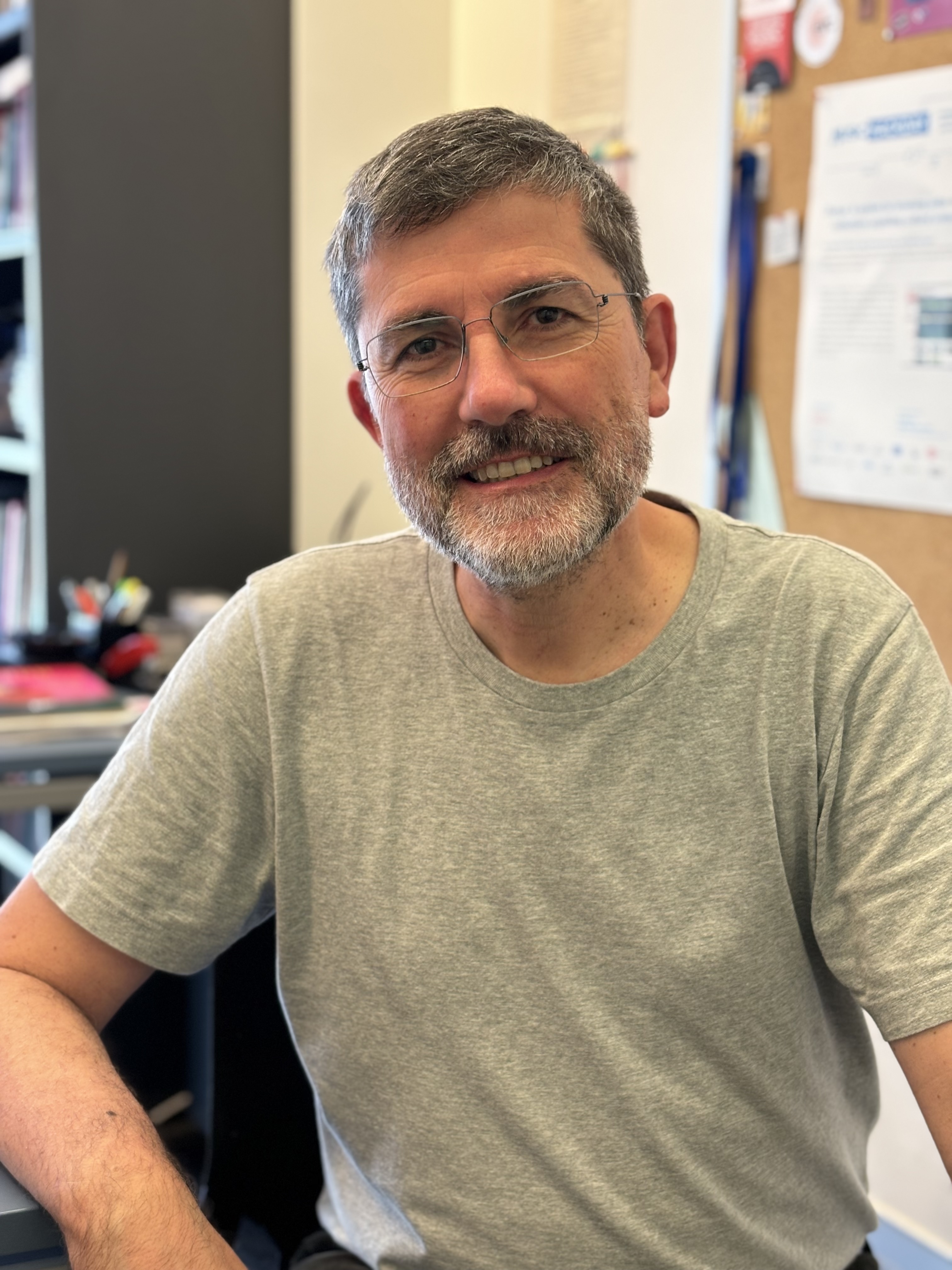
Xavier Serrà is the director of the MTG, the Music Technology Group at the Universitat Pompeu Fabra in Barcelona, where I was working during the past winter semester. From the moment I met him, I found him to be a fascinating person, not only for his impressive resume and for having done his PhD at Stanford University, but also for the many projects he leads at the university. When I told Xavier about the possibility of an interview, he didn’t hesitate at all; in fact, we made an appointment for the next day. From the beginning, the conversation was very pleasant, and we were able to go through most of his professional life. I hope you enjoy reading it as much as I enjoyed conducting it.
Tell me a little about yourself and your academic life, how did you get here?
I started studying music at the conservatory, but at that time the family also ‘pressured’ me, saying, why devote yourself to music? So, I also studied biology at the same time. As a result of this, I discovered my interest in mixing science and music from the very beginning. I was doing different classes at the Conservatory and I did some courses as well. My first teacher of subjects related to musical composition was Gabriel Brncic. That was my first contact with electroacoustic music and with contemporary thinking about music. This was, let’s say, clarifying my interest in studying things that linked technology and music. We are talking about the 70’s… the first computers in Barcelona were in the university and we could access them with perforated cards. And here, I started to do music and computer-related stuff. It was clear that in Spain, there was nowhere to study these kinds of things and so I got a scholarship to go to the United States. I did a master’s degree in music, first at the University of Florida, and then I did my doctorate at Stanford and I became more and more specialized in music technology and more and more in signal processing, more and more in engineering. And then, I finished my PhD there, worked at Yamaha in research, and I was looking forward to going back. Then I got some scholarships to go back to Spain and I joined Phonos. In Spain, I was still not doing many things, but there were more possibilities. It was the beginning of the 90s, there were the Olympics and many things were opening up, including the Pompeu Fabra University and the Conservatory (ESMUC). So, there were possibilities to try to find connections and get a place at Pompeu Fabra as a professor.
You have had a super interdisciplinary career, from music to biology and technologies, although music has always been the connecting link between all the other disciplines, hasn’t it?
Yes, yes.
I also read that you met Steve Jobs?
Yes, well, when I finished my Ph.D. there was a chance to work with him at his company NeXT Computer, Inc. (later called NeXT Software, Inc.). When he created this company, which was the first music computer in a way, he got quite a few of the researchers from where I was working. There was a team that was developing the synthesis processing chip in the computer […], but instead of going there, I went to work for Yamaha.
Were you more interested in Yamaha’s offer?
Yes, Yamaha was more musical. I felt more comfortable.
So, since your Bachelor’s degree in biology, did you always intend to do something with technology, or did that come later?
From the very beginning, let’s say. First, there was science in the most generic way and, for example, I studied issues of animal behavior and the sound related to the status that animals had in a colony and we did statistical work and things like that – all this, I was 14 years old, eh [laughs] -. But as soon as I could see that in those years the first books on algorithmic composition with composers like Xenakis and Sweet started to come out… it was clear that it was the beginning of computer science and the beginning of the use of computational methods in different aspects of creation.
Tell me now, what is the MTG and what does it do?
The MTG is a research group in the engineering fields. There is a lot of collaborative work, so there is a need to work with other people. When I joined Pompeu Fabra, I was alone, and naturally it was necessary to create a group, get resources, get money to be able to pay doctoral students, undergraduate students and be able to put together, let’s say, a team and have projects in collaboration with companies, with public funding, to advance a little in the idea of developing technologies that were useful for the different areas of music. This has changed a lot. First, I was focused only on creating synthesizers for music technology, because, when I started, this involved making a synthesizer. Now it doesn’t. So, over the years, the use of technology and computer technology in particular has been encompassing much more diverse topics. And now, the synthesis part, which was the original, is probably one of the least worked on.
What are you working on the most?
Now, it is obviously everything related to artificial intelligence. The great development that has taken place has been to support the entire music distribution sector, streaming systems, Spotify, etc. Therefore, technologies that help to organize, to catalog, to recommend music and to support the companies that manage the rights and manage the content and disseminate it online.

The next question is a little bit linked to this answer, what are the job opportunities for students who come here?
Now it is very big because these sectors have really grown a lot. There are many companies that used to make synthesizers, which were only a few. There was Yamaha in Japan, there were some in the United States, and therefore it was quite a small sector and now there are infinite companies, from Google to Amazon, they all have groups of developers and researchers that have to do with music. In addition, it is clear that there are still those using traditional audio. But our field is this information technology sector of web systems and online music content management systems.
The MTG does tremendous work that is very relevant for our times. However, it seems to me that, in many other parts of the world, music and musicology are still treated as very traditional disciplines. Conservatories are still very traditional and strict and musicology does not give much room for creativity – I speak partly from my own experience. How do you see this, and what could be done to make educational institutions aware of the importance of technology and innovation in music and the study of music?
Let me give you an example. When I returned to Spain, I had several job possibilities. One of the possibilities was that I joined and helped to create the conservatory. Therefore, that would have been to join the musical tradition and do something from within. Another possibility was the Pompeu Fabra University, a new university that wanted to open new fields. It is clear that I opted for Pompeu Fabra after trying and trying in the conservatories. It is very hard to break with traditions, even if it is a new conservatory, it is very difficult. In the Anglo-Saxon context, it is not so difficult. In the United States or in England, music is part of the universities and therefore, the interdisciplinary nature is already there. To be able to make degrees between several departments is easier, but in the traditional German, French, Spanish or Italian European context, it is very difficult to change the tradition of the study of music and introduce a type of study, a type of approach that requires a different teaching and management of music. So, it is very difficult in the purely musical fields to introduce these changes or these new ways of playing, studying and doing research.
Somehow the tradition is there, it doesn’t move. Once I went to a congress of the German Musicology Research Society in Berlin, a big, very international event that brought together a lot of people from all over the world. What surprised me the most was that everything was in German, everything! I understand that we were in Germany, but it was an international congress and there were only a handful of lectures in English, the rest was all in German. There were many people from other countries who had come and who did not necessarily speak German or whose level of German was not high enough to understand what was being said in an academic language, there was even a professor from Harvard there who did not speak German either….
Of course, musicology was born in Germany, so when you go to musicology congresses, there is still a part of it in German, even in the international ones, which is brutal…
Tradition is strong, isn’t it?
Yes [laughs].
Speaking of musicology, a term that I find very interesting and innovative is Computational Musicology. Could you tell me what it is and how it is applied?
It is clear that terms are things that appear, change and are sometimes opportunities to propose a new approach. Over time there have been different terminologies that have been used, for example, systematic musicology or computer music or music technology. I like computational musicology and it is nothing new, since there is also computational linguistics, for example. So, in a way, it emphasizes the methodology within the discipline of musicology. In other words, what we are saying is musicology and as a tool to understand music, to study the problems we want to face, we simply use computational methodologies. It is not a new field of research, but it does represent it, because it is clear that the types of problems you can tackle with computational methods are different and have to be different because you can use them with other types of technologies. Therefore, for me it is a terminology that goes in the sense of saying no, we do not do musicology, we want to understand music, we want to study the musical phenomenon, but the methodology we use is very important, so important that we define a subcategory within musicology.
So, this can be applied to any field of musicology… do you have to be an expert in technologies to use it?
No. Like any interdisciplinary discipline, there is always a gradient of profiles and ways of working. It is clear that, if computational musicology is done within a traditional musicology department, then the computational part will be small and it will be a tool where you will not put emphasis on the development of tools, but you will put emphasis on the use of existing tools. We, in our context within the Engineering department, put emphasis on the development of computational methodologies.
What would you recommend to a musician (classical or popular) or musicologist who is interested in music technology and innovation, but has no previous studies in technology or does not know how to create algorithms, for example? What would be the steps to enter this world of music technology?
Well, it depends on what you want to do. It is clear that you can take advantage of existing tools and be a user of these programs, of these technologies, of these environments that may exist or you can get more into programming and go into more detail. I think you have to go into a bit more detail, especially now with the existing systems or applications, I think they don’t allow you to do too much sophisticated research. As a user yes, because you go into a repository and you can use the available technology to do a little bit sophisticated searches of the contents, but you can’t do much more. If you want to do searches or you want to, let’s say, analyze a certain musical repertoire that is a relevant contribution to research, then you have to program and you have to work from organizing corpora and organizing datasets that are not done, and to do that you need a certain computational competence. In the current research of computational musicology, the main challenges are sincerely in the creation of datasets and corpora, that is to say, in being able to have well-organized, well-catalogued data, that allow to make the computational analysis on top of it. But the dataset, the corpus by itself, is already research, it is very, very valuable and it is an effort that sometimes many people do not want to make because it is a bit heavy.
It’s repetitive too…
Yes, but that is where the challenges are and where you can make more progress and do things that can have a greater impact. There is no corpus, there are no datasets to be able to do computational musicology that can compete, let’s say, with other fields of knowledge.
That’s a bit more sophisticated for a musician. Wouldn’t it be better to have a collaboration, for example, between a musician and an engineer?
Well, the other approach is this. It is clear that the typical musicology work is very individual. In our field that is impossible, and therefore we collaborate with many musicologists. These collaborations are very fruitful. For musicologists who are interested in these kinds of tools, the other possibility is to collaborate with groups like ours, the MTG, where we can find problems that are of interest to both of us. One of the most musicological topics we work on, for example, is Indian music. We have been working for quite a few years and have collaborated with many musicologists and musicians who help us create the data, analyze it, draw conclusions, and so on. In topics more related to music pedagogy, we are also working to be able to analyze the students’ interpretations and to be able to help give feedback, because here we also collaborate with pedagogues, musicians, etc.
In other words, the leap for a musician does not have to be so drastic, nor does he have to become a computer scientist overnight…
No, no, far from it. In the end, they are interdisciplinary groups and you have to know how to work with groups of interdisciplinary and collaborative interest, which is difficult for many musicians, because they are used to being alone all the time.
Of course, most of a musician’s life is spent alone studying, preparing concerts, etc.
Yes, yes.
In closing, how do you see the future of music technology?
Well, we are in a fantastic moment, really. And for me one of the most fantastic things is that it is clear that we are in the moment of artificial intelligence, a moment where these technologies are in everybody’s hands and there is a social debate about this. This is fantastic! When you’re in a field of research that’s on everybody’s lips, it’s much better than being in a library on your topic and nobody giving a damn about what you’re doing. So, to be in a subject that I can talk to my mother, that I can talk to whoever on the street understands what we’re doing and that I have the responsibility to do something that is useful to him or them, I think it’s a fantastic situation. We are doing things that have utility, that can be dangerous, that have their challenges, but are in the social reality of now and that is more interdisciplinary than ever. We are using the same tools used by biologists, aeronautical engineers or whoever, and we are also sharing tools, so we are in a field that is not isolated from everything, but we are in the middle of what is happening both at a social level and at a scientific and technological level.
Look, I had never thought about it like that, that all sciences are on a par in terms of methodologies, topics, uses, benefits and that you can be part of it too, it’s incredible! So you predict a good future for it?
Yes, yes, of course!
What are your favorite music platforms?
Let’s see, I use Spotify [laughs]. I know that I would have to diversify… I listen to classical music above all and yes, there are platforms that would be better or European platforms, but well, comfort can – it wins – and in the end I use Spotify.
It’s all there, plus it’s easy to use [laughs]. Now yes, the last question, what is your favorite album, composer, piece of music? It can be classical or popular music… whatever!
Messiaen’s «Quartet for the End of Time.»
Wow, it’s super dense music. It’s not to be listened to in the bathroom while taking a shower….
Not this! [laughs], it’s one of the pieces that I listen to from time to time […] I always listen to it…
What meaning does it have, does it bring back any specific memory?
I play the cello, so there the cello has a very important role and the story behind it… yes, yes. I like it very much!
I didn’t expect that answer, so it was the surprise of the day. Thank you very much for your time to do this interview!
Thank you very much to you!
If you are not familiar with the «Quartet for the End of Time» by French composer Olivier Messiaen (1908-1992), here is a version to introduce you to this intriguing piece of music.
 Music & Beeats
Deja un comentario