
Have you ever had the experience of attending a concert with a massive orchestra, where over eighty musicians fill the stage with their presence and their music fills the air with overwhelming energy? Or perhaps you have witnessed a popular music concert where the stage overflows with performers and the sound reaches levels that defy the limits of human perception? In our current age, it’s easy to fall into the belief that a packed stage and deafening volume equate to a higher quality musical experience or a greater capacity for enjoyment. While this assumption has a grain of truth to it, as loud music can incite singing, dancing, and other forms of expression, there is another type of music that can elicit more subtle, but equally powerful physical responses, such as the familiar sensation of «goose bumps.»
After many years immersed in the vibrant world of music, I have concluded that simplicity is a crucial element. This notion may seem a bit old-fashioned in an era where complexity and speed are the norm, but when it comes to sound expression, I am firmly convinced that «less is more.» This philosophy, popularized by the renowned German-American architect Ludwig Mies van der Rohe (Aachen, 1886 – Chicago, 1969), transcends the creative fields of architecture and design and finds a profound echo in the world of music. The essence of music lies in its ability to convey emotions and cause an emotional response in the listener. Often, this connection is best achieved through clarity and purity of melody and harmony. In moments of musical simplicity and vulnerability, the space for contemplation and deeper reflection opens up. Like a blank canvas waiting to be filled with brushstrokes of emotion and meaning, simple or minimalist music invites the listener to immerse themselves in their own inner experience.




Architect Ludwig Mies van der Rohe and some of his most famous works:
1. Seagram Building in the USA.
2. Barcelona Pavilion in Spain.
3. Federal Chicago Center in the USA.
Pictures taken from: https://stylishclub.pt/news-media/mies-van-der-rohe-less-is-more/
Often, the music that makes our skin crawl is music that touches on universal themes such as love, loss, hope, or nostalgia. These themes, combined with masterful playing and heartfelt interpretation, can reach deep within us, and resonate with our own experiences and feelings. Systematic musicology, along with various branches of psychology and medicine, has been dedicated to studying this effect on people and understanding what specifically causes these dopamine discharges when we listen to something we like, and which gives us pleasure. This is undoubtedly a complex subject, but in this post, as usual, I will speak from my own experience. Some of the examples that have transported me to another world and have made my skin crawl every time I listen to them exist in the world of classical music as well as in others.
The first example is the work La fille aux cheveux de lin (The Girl with the Flaxen Hair) by French composer Claude Debussy (1862-1918). As its name suggests, this work is of extreme innocence and delicacy and is part of the book Préludes, Livre 1 (Preludes, Book 1), a compendium of 24 short pieces for solo piano composed between 1909 and 1919. Debussy is widely recognized as the first composer associated with Musical Impressionism. However, what exactly does the term «Impressionism» imply in music? Musical Impressionism was an artistic current that developed in France in the late 19th and early 20th centuries. As in painting, where impressionists sought to capture the essence of a scene through loose, evocative brushstrokes, impressionist composers sought to convey impressions and moods through music, creating suggestive atmospheres that evoked images and sensations in the listener’s mind.



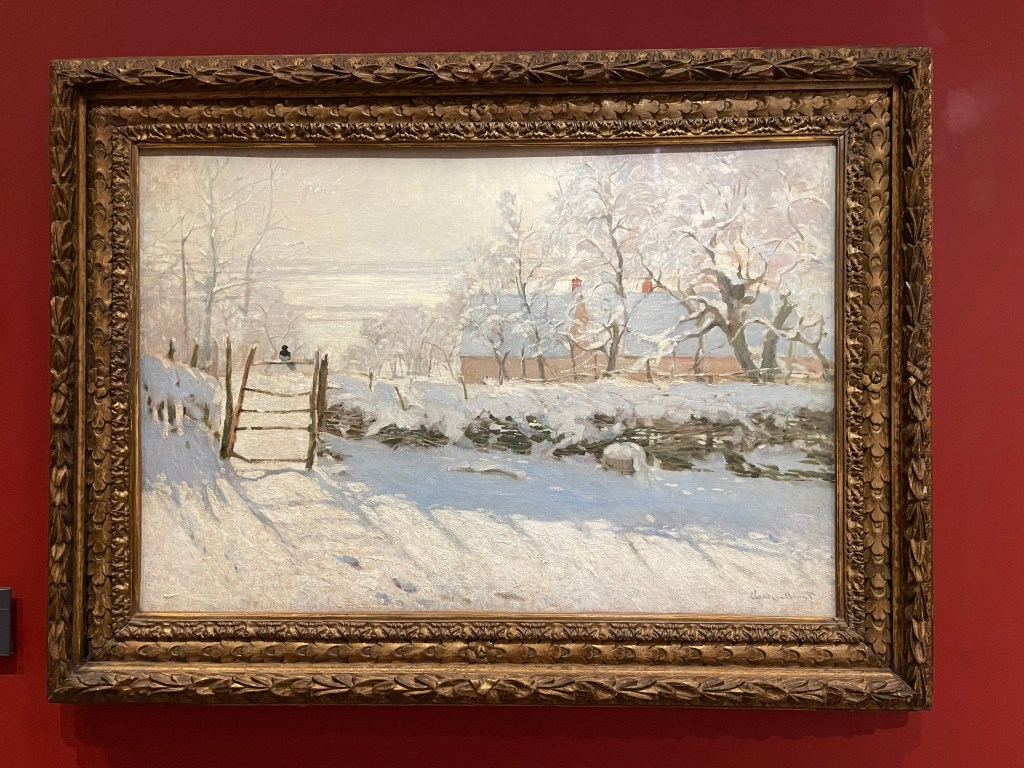

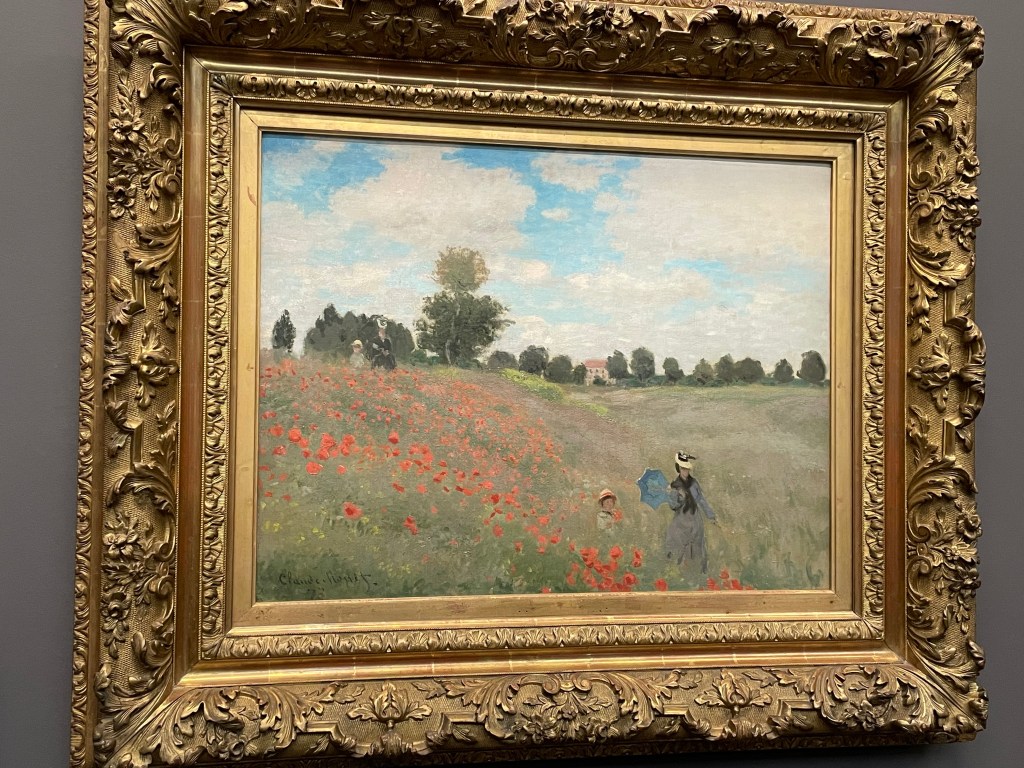

During the summer of 2023, we visited the Musée d’Orsay in Paris. One of the greatest exponents of impressionism in painting was the Frenchman Claude Monet (1840-1926). In the photo slideshow, you can see some of his works in the permanent exhibition of the museum:
1. Trouée de soleil dans le brouillard (Sun Breaking Through the Fog, Houses of Parliament), 1904.
2. Nymphéas bleus (Blue Water-Lilies), 1916–1919.
3. Le Bassin aux nymphéas, harmonie verte (The Lily Pond, Green Harmony), 1898.
4. La Pie (The Magpie), 1868–1869.
5. Femmes au jardin (Women in the Garden), 1866.
6. Coquelicots (Poppy Field), 1873.
7. Visitor’s Guide to Musée d’Orsay.
The first time I heard the piece La Fille aux cheveux de lin was during a concert of the Chilean Symphony Orchestra when I was still at school. I don’t remember exactly what the concert was about, but I do remember clearly how the pianist, who had just played as a soloist with the orchestra, began to play this Debussy miniature for the encore. I was completely mesmerized by its magnificent beauty. Because I was seated quite far from the stage, I could not hear the pianist presenting the encore well, so at the end of the concert, I ran to find my friend Cristián Gutiérrez, cellist of the orchestra, to ask him the name of this work. Cristián told me a little about the piece and about Debussy, whom I hardly knew in those years. When I got home, the first thing I did was to search for the piece on YouTube, so I could listen to it again. From that moment on, I was deeply captivated by Claude Debussy’s music and began to consider him a genius. How could I not, when Debussy entered the prestigious Paris Conservatory when he was only 10 years old? In the following video, you can listen to a beautiful version of the work performed by the great Italian pianist Arturo Benedetti Michelangeli and recorded in Paris in 1978.
I could go on much longer about Debussy and Impressionism, but I will leave that topic for later. In this post, I intend to demonstrate that beauty in music can also be found in simple works. In the more recent orchestral repertoire, specifically in movie soundtracks, we can also find wonderful and evocative works. One of my favorite composers in this field is the American John Williams (1932), who captured simplicity in his soundtrack for Steven Spielberg’s Schindler’s List (1993). It is impossible to listen to this piece and not be moved to tears, especially when it is Itzhak Perlman who plays the film’s main theme on his violin. Williams has been a regular collaborator on Spielberg’s films. However, when Spielberg presented the project to him, Williams considered it too difficult to carry out, mostly because of the emotional burden it entailed, and told him, «You need a better composer than me for this film.» To which the director replied, «I know. But they’re all dead!».
As a last example, I will refer to popular music. Countless songs make our skin crawl, either because of their lyrics or their melodies. Some examples that come to mind are Love Me Tender by Elvis Presley, Yesterday by The Beatles, Somewhere over the Rainbow performed by Israel «IZ» Kamakawiwoʻole, in a cover of the song of the same name from the movie The Wizard of Oz (1939), Love of My Life by Queen among many others. This list could be endless if we also consider personal tastes and the diversity of popular music in all the languages of the world. However, here I will focus on two duos that I like because of their emotional and simple music. The first is Simon & Garfunkel, who, despite their complicated professional relationship, managed to create memorable and thought-provoking songs. Two of my favorites are The Sound of Silence, recorded in 1964, and Bridge over Troubled Water, released in 1970. The latter moves me the most each time I listen to it. The other duo is The Carpenters, formed by siblings Karen and Richard Carpenter in the late 1960s. One of their most delightful songs is Close to You (1970), where Karen’s beautiful voice stands out.

Lyrics taken from: https://genius.com/Simon-and-garfunkel-bridge-over-troubled-water-lyrics

Lyrics taken from: https://www.azlyrics.com/lyrics/carpenters/theylongtobeclosetoyou.html
In a world full of distractions and noise, it is as if these skin-tingling melodies have the power to stop time around us and give us a moment of deep connection with our complex inner world. Music that makes our skin crawl can manifest itself in many ways: a beautiful melody, a violin solo, a special harmony, and so on. I find that it is the simplest songs that often have this emotional impact. This highlights the power of music to connect us to our deepest emotions. When you attend a concert or simply sit down to listen to music, pay attention to those moments that give you that special feeling, for this is where the true «magic» of music manifests itself. You don’t need to wait to hear something complicated; sometimes beauty and emotion can be found in the simplest of songs. Remember, less is often more!
References:
- Musée d’Orsay, Paris. https://www.musee-orsay.fr/en

 Music & Beeats
Deja un comentario