When thinking about what my first content post should be, my head went wild exploring all the possibilities out there. I was also looking for a topic that could encompass all the things I love besides music, and that would best reflect the spirit of this blog. Having said all that, this first post will be dedicated to a song I discovered many years ago. It’s an old Irish folk tune called “Mo Ghille Mear” (My dashing hero). A friend and I traveled to Ireland for a few days in the summer of 2012, and I vividly recall being utterly captivated by the country’s culture. Dublin’s vibrant atmosphere, with its friendly locals and ubiquitous music, left me pleasantly surprised. My limited prior knowledge of the country likely contributed to my sense of wonder at everything I encountered. Shortly after our arrival, my friend and I ventured to a bar –or better said, pub– featuring live music, where I found myself entranced by an older gentleman performing traditional Irish folk music with his band. Although I didn’t comprehend every word he sang, the music spoke to me on a profound level. Every song, as simple as they were, was more wonderful than the other. There was, however, one song I could sing along, and it was the case for most people at that pub in the heart of Dublin. Before Ed Sheeran’s popular “Galway Girl” song came out in 2017, there was another one called “The Galway Girl” written by American songwriter Steve Earle. In this partially autobiographical tune, Earle recounts the tale of encountering a stunning girl with black hair and blue eyes in Galway, the West of Ireland. This song has been the subject of many covers and was also made popular by the movie P. S. I love you (2007). In any case, that night, this song was the loudest one in that pub. From that moment on and in an unconscious way, my musician’s ears were being opened to new folkloric sonorities.
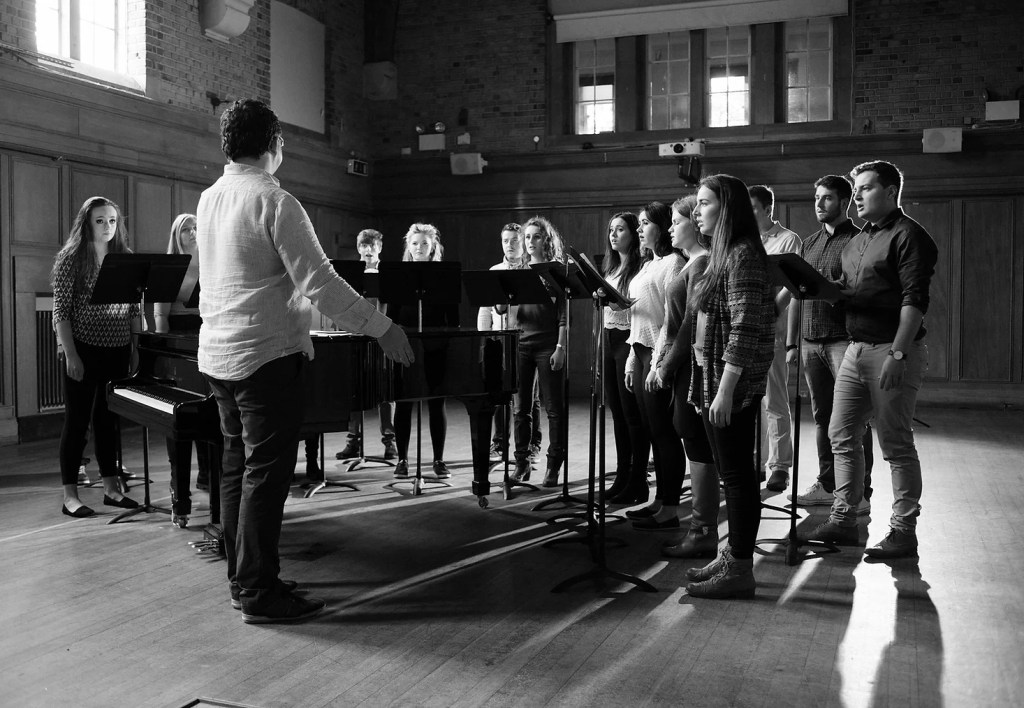
The Choral Scholars of University College Dublin rehearsing (picture taken from their website, https://www.ucdchoralscholars.ie/).
As I previously mentioned, this post is about “Mo Ghille Mear,” a fascinating illustration of the intertwining of romance and the political situation of its time, as it was composed during the Jacobite uprising of 1745. Jacobitism was a political movement that sought to reinstate the House of Stuart to the British throne. “Jacobitism” is rooted in the Latin name “Jacobus,” directly associated with James II of England and VII of Scotland. This movement gained momentum following James II’s removal from power during the Glorious Revolution of November 1688. After his exile, Parliament declared that James had abdicated the English throne, leading to the ascension of Mary II and William III. This pivotal event marked the genesis of the Jacobite cause and challenged the legitimacy of the newly established Protestant rulers. The rebellion of 1745 was led by Prince Charles Edward Stuart, also known as Bonnie Prince Charlie, and by his Jacobite supporters as Charles III of England, Scotland, and Ireland. It aimed to regain the throne lost by his grandfather in 1688. Although Prince Charles had some support in Ireland since the Irish Jacobites sympathized with the cause, most of the action happened in Scotland, where it culminated in the Battle of Culloden in 1746. Regardless of this, “Mo Ghille Mear” remains an Irish tune whose lyrics are based on poems written in Gaelic by Seán «Clárach» Mac Domhnaill (1691–1754). It is common to find translations of its title as “my gallant hero”, “my gallant star”, and “my dashing darling”. The text portrays a lament from the Gaelic goddess Éire, mourning the fate of Bonnie Prince Charlie exiled in France following the tragic outcome of the 1745 battle. Even though he is depicted as a brave hero, Bonnie Prince Charles was believed to have not been that heroic. Here’s a glimpse of the lyrics translated into English:
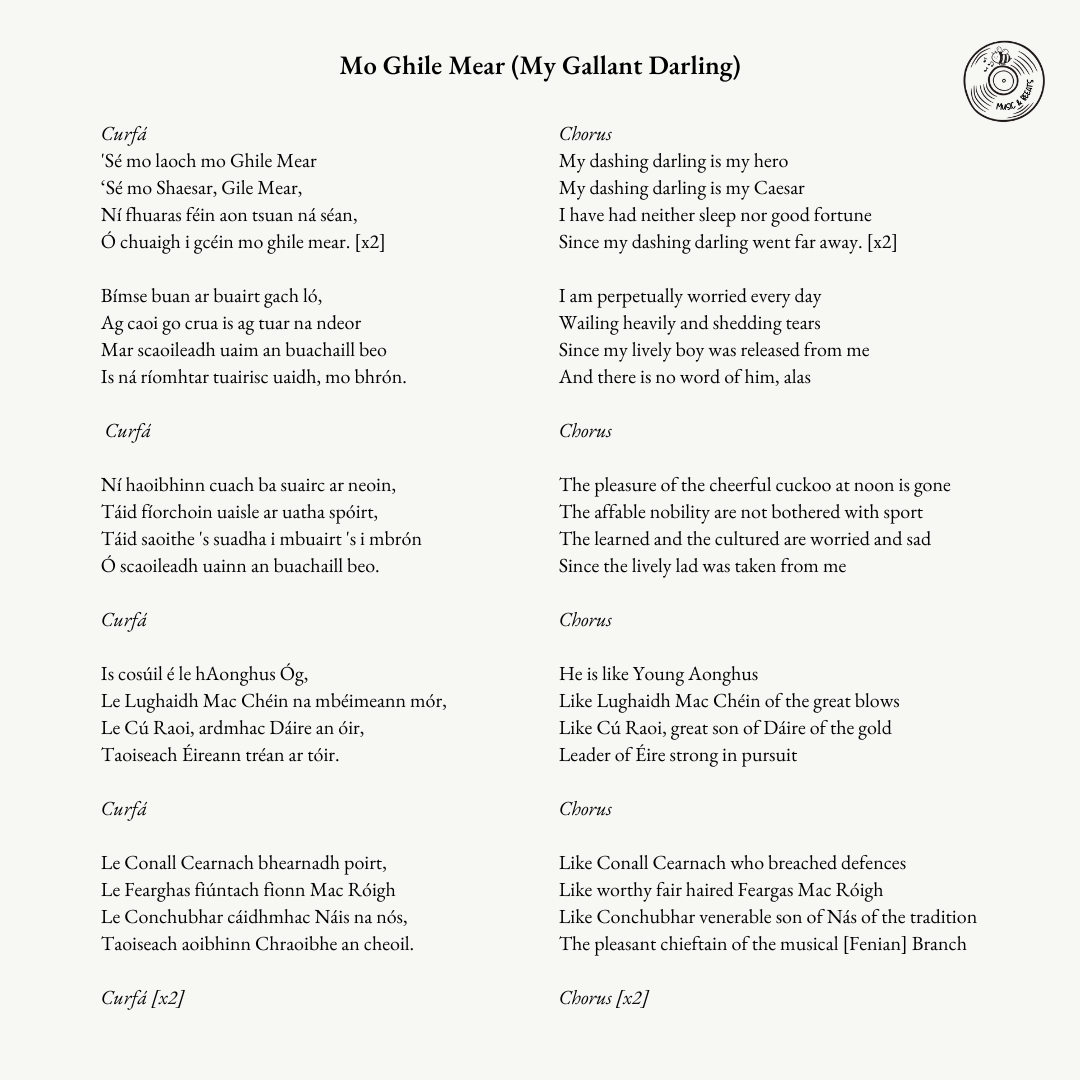
Lyrics taken from: https://songsinirish.com/mo-ghile-mear-ucd-lyrics/.
Disclaimer: This translation is not definitive and has been provided for the purpose of this text. For a more accurate interpretation, it is advised to collaborate with a linguist who specializes in Gaelic-English translations to ensure a comprehensive understanding of this ancient song.
My favorite version of “Mo Ghille Mear” is sung by the Choral Scholars of University College Dublin. What I like most about it is the simplicity of the musical arrangement by Desmond Earley, composer, arranger, performer, a specialist in performance studies, who happens to be the director of this student’s choir since 1998. This beautiful arrangement allows the vocals and the harmony they create to take center stage, resulting in what to me would be something close to musicalizing purity and strength. Mark Waters is the tenor soloist in charge of singing the whole song and is accompanied by a choir that explores different dynamics. Later, a bodhrán, an Irish drum attributed to the Celts and originally made of goatskin, bursts in. This instrument is open on one side, where the musician can control the tuning and timbre of the instrument and is played with a cipín, a kind of Celtic drumstick. This song is the first track from the choir’s first studio album titled Invisible Stars – Choral Works of Ireland & Scotland which was released in 2015. Since then, they have released two more studio albums, Perpetual Twilight (2019) and Be Merry (2020). If you are a fan of choral music, I recommend exploring these three album productions, as you will find beautiful and fascinating music with unique arrangements.
Another version of this song that I love is by The Chieftains, an Irish traditional music band, founded in Dublin in 1963, together with Sting, the famous British musician and former bassist of The Police, whose paternal grandmother was of Irish descent. The lyrics of this version are much more simplified but maintain the heroic spirit of the original version. What I like most about this version is its rustic character, with sonorities that can illustrate the Irish countryside and the cheerfulness of its people.
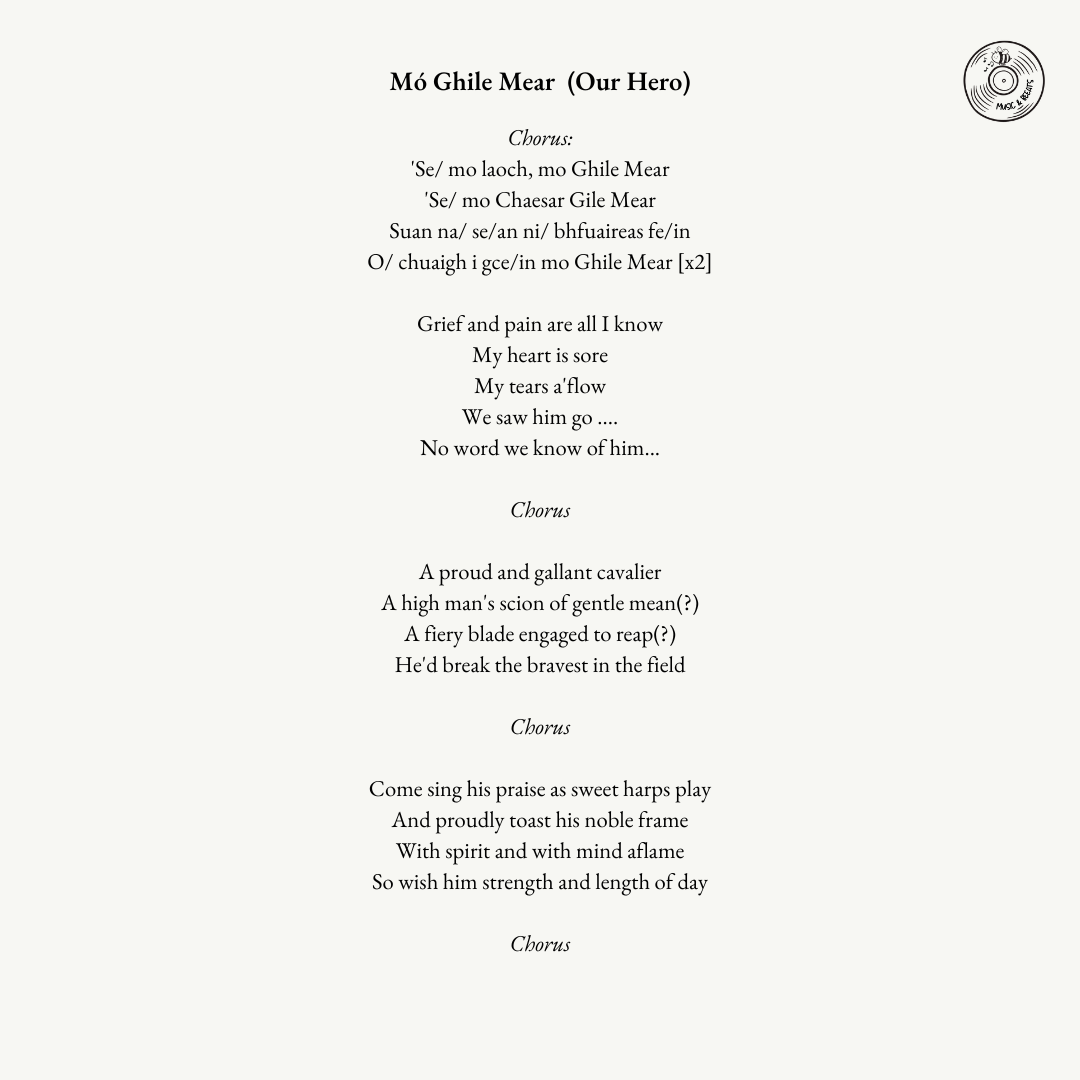
Lyrics taken from Sting’s website: https://www.sting.com/discography/lyrics/374/
“Mo Ghille Mear” is undoubtedly a gorgeous song that somehow illustrates the optimism of Irish people and their culture. If you wish to further delve into Irish folk music, its versatility, and its dialogue with other musical genres, I recommend listening to the complete album by The Chieftains entitled The Long Black Veil, where you will find this latest version of “Mo Ghille Mear.” On this album, The Chieftains not only collaborate with Sting but also with other big names in the music industry, such as Mick Jagger and the Rolling Stones, Sinéad O’Connor, Ry Cooder, and Tom Jones, among others. For me, the gems of this album are the tracks “Foggy Dew” (3) and “Tenessee Waltz” (12). In “The Foggy Dew,” Sinéad O’Connor passionately portrays the events of the 1916 Easter Rising, passionately portrays the events of the 1916 Easter Rising, where the Irish were urged to prioritize their fight for independence over being drawn into World War I, seen as serving British interests. The second song tells of a love that left with another as they danced to the sounds of the wonderful Tenessee Waltz. The lyrics are much simpler than those of «The Foggy Dew,» yet it is the undisputed drama and depth conveyed through Tom Jones’ voice that makes this song stand out above the others.
I hope you found this post interesting! Feel free to share your thoughts on the topic or let me know if you were already familiar with this song.
References:
- Hemphill, P. (2022, October 1). Mo Ghile Mear – Irish myth and melody. In That Howling Infinite. https://howlinginfinite.com/2017/07/20/mo-ghile-mear-in-irish-myth-and-melody/
- John Erskine, 6th earl of Mar | Jacobite, Rebellion & Exile. (2024, January 28). Encyclopedia Britannica. https://www.britannica.com/biography/John-Erskine-6th-earl-of-Mar


 Music & Beeats
Deja un comentario